Rental Real Estate (Single Property)
EditThe classic passive-income asset, with the classic gap between pitch and reality. The math still works in 2026 — but only in specific markets, with realistic financing.
The honest take
Rental real estate is the most romantically pitched and most operationally misunderstood passive-income asset on this site. The pitch — “buy a property, rent it out, collect checks while it appreciates” — is real but incomplete. The reality:
- Most US single-family rentals at 2026 prices and rates have monthly cash flow under $300 after all real expenses.
- The 5-year total return is dominated by appreciation and principal pay-down, not cash flow. If your area doesn’t appreciate, your returns are mediocre.
- It’s not as passive as advertised. A “passive” rental still takes 4-8 hours/month average and 20-40 hours during turnover.
In 2022-2023 the US rate environment shifted from 3% mortgages to 6.5-7.5%. That single change moved single-family rentals from “obvious cash flow” to “marginal cash flow” in most markets. The math still works in 2026 — but only with realistic assumptions, the right markets, and a willingness to think in 5-10-year horizons rather than monthly checks.
If you have $40-$80K for a down payment + 6-month operating reserve and you’re willing to accept that real-world returns are 6-12% IRR (not the 25%+ the gurus advertise), this can be a defensible piece of a passive-income portfolio. If you need monthly cash flow this year and you’re tempted by leverage to make small deposits work, you’ll likely lose money on the first deal.
What this is (and what it isn’t)
Owning a single-property rental means buying real estate (typically a single-family house, duplex, or condo) and renting it to tenants for monthly income while the asset (hopefully) appreciates over time.
What it is:
- A capital-intensive asset class that combines four return drivers: cash flow + appreciation + principal pay-down + tax shelter.
- A genuinely passive asset after the build-out — find property, finance it, hire property manager (if desired), collect.
- A leveraged asset class — your $50K down can control a $200K asset, multiplying both upside and downside.
What it is not:
- “Mailbox money” without active management. Even with a property manager, you make decisions, approve repairs, handle vacancies.
- Universally a good investment. In 2026, many high-cost-of-living US markets (CA, NYC, MA, parts of FL) have rentals where monthly costs exceed monthly rent.
- A short-term play. Real estate is a 5-15 year asset class. Buying with a 3-year horizon is gambling on appreciation timing.
How much you actually need to start
| Item | Cost (US single-family, $200-$300K range) |
|---|---|
| Down payment (25% for investor financing) | $50,000-$75,000 |
| Closing costs (~3% of purchase price) | $6,000-$9,000 |
| Initial repairs / make-ready | $3,000-$8,000 |
| 6-month operating reserve | $7,000-$12,000 |
| Property inspection + appraisal | $700-$1,200 |
Realistic floor: $65,000 total for a $200K purchase in a moderate-cost-of-living US market. Realistic ceiling at this entry tier: $120,000 for a $400K purchase in a higher-cost market.
For EU investors, the math differs by country dramatically — Germany, Spain, Portugal have lower price points and different financing mechanics; Bulgaria, Romania, Poland have $40-$120K entry-tier properties with 6-9% gross yields.
The capital requirement is the largest of any idea on this site. This is also the highest-capital tier on TierIncome.
The honest math
Plug your own numbers into the calculator below. The defaults assume:
- $220,000 purchase price (mid-range US single-family in moderate-cost market)
- 25% down payment ($55,000 cash) at investor mortgage rate
- $1,700 monthly rent at market rate
- 40% expenses of rent (taxes, insurance, vacancy, maintenance, capex reserve)
- $1,050 mortgage P&I at ~7% on a 30-year fixed for $165K loan
That gives you ~$210/month cash flow at the calculator defaults — about 5% cash-on-cash return. Add ~5% annual appreciation (assumption) and ~3% annual principal paydown, and your total IRR over 5 years is roughly 12-15% including the leveraged appreciation effect.
That’s not the 25-40% the gurus pitch. It is, however, better than most index-fund portfolios over the same period in real terms when you account for tax shelter and inflation hedging. The math works; just don’t expect Twitter-influencer numbers.
What works in 2026
The 2022-2024 rate-rise environment shifted the rental-investing playbook substantially. The 2026 winners share patterns:
1. Mid-cost-of-living US markets
The 2026 sweet spot for US rental cash flow: $150K-$300K properties in growing secondary markets — Tennessee, Indiana, Ohio, Pennsylvania, Texas exurbs, Carolinas, Georgia. Properties below $150K often have deferred maintenance time-bombs; above $300K, monthly cash flow goes negative without unrealistic appreciation.
2. EU markets with stable yields
Germany, Spain (especially second-tier cities), Portugal (despite recent regulatory shifts), and Eastern EU (Bulgaria, Romania, Poland) offer 6-10% gross yields at entry-tier capital ($60K-$150K). Lower appreciation than US growth markets, but more predictable cash flow.
3. Turnkey acquisitions, not deep value-add
The pre-2022 “buy distressed, rehab, refinance” model still works but requires expertise most beginners don’t have. The 2026 first-time buyer wins more often by buying tenant-occupied or rent-ready properties at fair prices through Roofstock or local agents — accepting moderate margins for operational simplicity.
4. Property management from day one
Self-managing your first property to “save the 8%” is the most common first-time-investor mistake. Hire a property manager (8-10% of rent) unless you’re local AND willing to handle late-night calls. The ROI gap between self-managed and PM-managed is rarely worth the time-cost reality.
5. Conservative leverage
Investor-loan rates of 6.5-7.5% in 2026 mean leverage above 75% LTV often produces negative cash flow. Stay at 75-80% LTV maximum for first acquisitions.
What does NOT work in 2026
- High-cost-of-living coastal markets (Bay Area, NYC, Boston, much of LA) — rentals there are negative-cash-flow appreciation bets.
- Short-term rental (Airbnb) plays without strict regulation research. Many cities banned or capped STRs in 2022-2025; assume your market is hostile until proven otherwise.
- 5%-down “house hacking” that makes you the de facto landlord living next door. Works for some; works against psychology and operational complexity for many.
- Buying based on speculative appreciation alone in 2026. Rate environment doesn’t favor speculation; cash flow has to make sense at acquisition.
- DIY property management for an out-of-state property. Predictably ends in tears.
The 2026 buy criteria
For each candidate property, score 1-5 on each:
1. Cash flow at realistic expense assumptions
- 5: Cash flows positive at 50% expense ratio + 10% PM fee.
- 1: Cash flows negative even at 30% expense ratio.
2. Local rent-to-price ratio
- 5: Monthly rent ≥1% of purchase price (e.g., $200K property at $2,000+ rent).
- 1: Monthly rent <0.5% of purchase price.
3. Local job-market fundamentals
- 5: Population growing, multiple major employers, low unemployment.
- 1: Single-employer town, declining population.
4. Property condition
- 5: Built post-2000, recently updated, no deferred maintenance signs.
- 1: Built pre-1960, multiple deferred-maintenance items.
5. Tenant profile (if occupied)
- 5: 1+ year on-lease, payment history, employment verified.
- 1: Vacant + no recent rental history, or month-to-month with payment issues.
6. Local landlord-friendliness
- 5: Tenant-friendly laws balanced; eviction timeline 30-60 days.
- 1: Tenant-friendly to the point of 12-month eviction risk (some CA, NY jurisdictions).
Buy only properties scoring 24+/30. Walk away from anything below 20.
The discipline at the buy step is what separates landlords who profit from landlords who become accidental subsidizers of their tenants.
The recommended stack
For a $10K+ tier rental investor in 2026:
- Roofstock for US out-of-state tenant-occupied acquisitions.
- BiggerPockets Pro for education + analysis tools.
- AppFolio or Stessa for ongoing financial tracking (Stessa free for single property; AppFolio paid for multi-property scale).
- TurboTenant for tenant screening.
- Local property manager (8-10% of rent) for ongoing operations — find via BiggerPockets community recommendations.
The “Recommended tools” panel below has affiliate links — same tools we’d recommend without the affiliate program.
Who this is for
- Someone with $50K-$100K in liquid capital they can invest in an illiquid 5-10 year asset.
- Someone with 6-month financial buffer outside the rental capital (vacancy, repairs).
- Someone willing to accept 6-12% IRR rather than chasing influencer-claimed 25%+.
- Someone with moderate operational tolerance — even with property management, you make decisions monthly.
- Someone in a stable life situation — divorces, job changes, and rentals interact poorly.
Who this is NOT for
- Anyone without the down-payment capital who’s tempted by “creative financing.” Don’t.
- Anyone who needs liquid capital within 5 years. Real estate is illiquid; selling has 6-9% transaction costs.
- Anyone who would lose sleep over a 2-month vacancy or a $4,000 surprise roof repair.
- Anyone in a high-cost-of-living market who has to buy locally to manage. The math probably doesn’t work.
- Anyone hoping for a quick equity flip. Wrong rate environment, wrong asset class for that strategy in 2026.
First 90-day action plan (this idea has the longest setup curve)
Month 1: education + market selection
- Weeks 1-2: Read BiggerPockets’ “Rental Property Calculator” guides. Understand the 1% rule, the 50% rule, the cash-on-cash return formula.
- Weeks 3-4: Pick 2-3 candidate markets (US: Memphis, Indianapolis, Cleveland, Pittsburgh, Birmingham; EU: depends on your home country). Research property prices, rent levels, vacancy rates, local laws.
Month 2: financing + property search
- Weeks 5-6: Get pre-approved for an investment-property mortgage. Talk to 3-5 lenders; rates and terms vary substantially.
- Weeks 7-8: Browse 30-50 candidate listings on Roofstock + Zillow + local MLS. Apply your buy criteria. Don’t make offers yet.
Month 3: offers + closing
- Weeks 9-10: Make offers on 2-5 properties scoring 24+/30. Expect 1-3 to fail (counter-offers, inspection issues, financing complications).
- Weeks 11-12: Close on the right property. Hire property manager. Onboard tenant if vacant; verify lease if occupied.
By end of month 3: first property closed, first month’s rent in escrow, property manager onboarded.
Realistic milestones
| Time horizon | What you should expect |
|---|---|
| Month 1-3 | Education + first acquisition |
| Month 4-6 | First rent payments. Likely first surprise repair ($300-$2,000). |
| Year 1 | $1,500-$3,000 net cash flow. ~5-8% appreciation if market cooperates. |
| Year 2-3 | Stabilization. Maybe second acquisition. |
| Year 5 | $30,000-$60,000 in equity (paydown + appreciation), $5K-$15K cumulative cash flow. |
| Year 10 | Substantial equity, fully amortizing toward paid-off rental. |
The variance is large and driven heavily by market choice and timing of acquisition. A 2020 acquisition in a Sun Belt market produced wildly different returns than a 2024 acquisition in a coastal market.
What can kill it
- A 2-month vacancy + a $5,000 surprise repair in the same month. Build the 6-month reserve specifically for this.
- Tenant-friendly jurisdiction shifts. A new local rent-control or eviction-protection law can crater your projected returns. Check legislative trajectory before buying.
- Local economic decline. A single-employer town losing its employer destroys your tenant base.
- Self-management fatigue. The “save 10% by self-managing” math kills your soul if you don’t enjoy the operations.
- Over-leverage at acquisition. 90% LTV in a 7% rate environment = negative cash flow + amplified loss if values decline.
The compounding case
A single-property rental held for 10 years with conservative assumptions (5% appreciation, 3% annual rent growth, 75% LTV financing) produces roughly $60K-$120K in equity, $15K-$40K in cumulative net cash flow, and a meaningful tax shield through depreciation. That’s a 75-150% total return on the original ~$60K capital deployment, with passive operational characteristics.
Stack 3-5 such acquisitions over 10-15 years and you have a real-estate portfolio generating $40K-$80K/year in net rental income with $300K+ in equity, alongside whatever appreciation the market delivers.
That’s not influencer-Twitter-numbers. It is a defensible, asset-backed wealth-building strategy with century-long performance data, tax advantages no other asset class matches, and inflation-hedging properties that paper assets can’t replicate.
If you have the capital, the patience for a 10-year horizon, and the operational tolerance for occasional surprise calls, single-property rental real estate is one of the most genuinely passive ideas on this site after the first 6-12 months. The first 6-12 months — finding the deal, closing, stabilizing the operation — are intensive. Plan for that intensity; don’t be surprised by it.
Rental property cash flow
Adjust the inputs to match your situation. Honest math — no hype.
Inputs
Results
Annual cash flow ÷ down payment. <8% means thin margins.
NOI ÷ price. Independent of financing. Compare with local market.
Recommended tools
Affiliate disclosure: links may earn TierIncome a commission at no cost to you.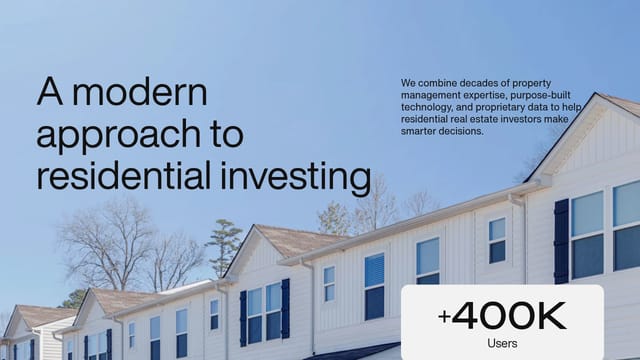
US-only marketplace for tenant-occupied single-family rentals. Best for out-of-state investors who want vetted properties with rent already in place. Reduces sourcing friction substantially.
Property-management software for self-managed landlords. Tenant screening, rent collection, maintenance tracking. Worth it once you have 2+ properties.
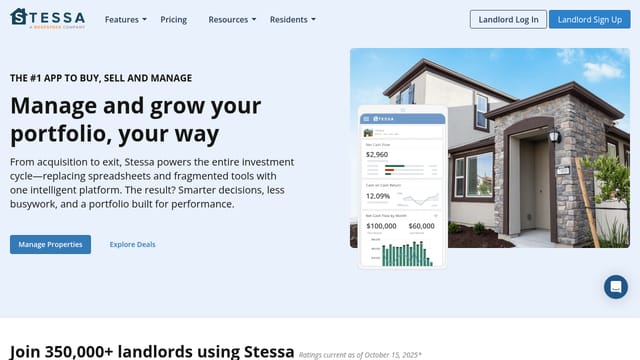
Free landlord-focused accounting + property tracking. Tax reporting at year-end is dramatically cleaner with Stessa than spreadsheets. Free tier covers most single-property setups.
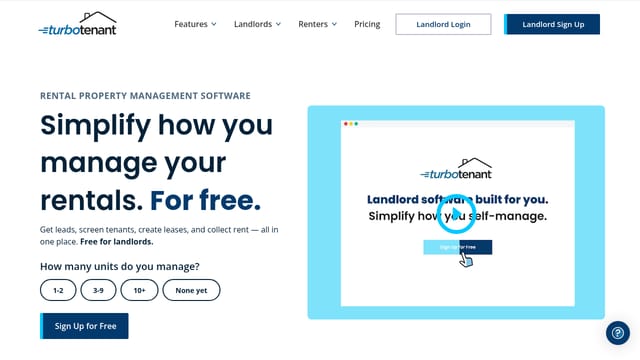
Free tenant-screening + lease management. Background check, credit check, eviction history all in one. Standard for self-managing landlords.
If your strategy is short-term rentals (Airbnb-style) instead of traditional 12-month leases, Hostfully is the property-management software of record.

Largest US real-estate-investing community. Free education content + paid Pro tier with calculators and analysis tools. The default learning resource for new landlords.