Buying a niche YouTube channel via Flippa or Empire Flippers
EditSkip the 12-24 month audience-build slog by buying an established channel — realistic 2-3x annual profit multiples in 2026, with operational risks most spreadsheets miss.
The honest take
Buying an existing profitable YouTube channel is one of the fastest ways to short-circuit the 12-24 month audience-build phase that kills most independent creator businesses. Instead of grinding for two years to reach monetization-meaningful scale, you write a check for $20-150K and acquire a channel that already produces revenue, has historical algorithm signal, and comes with a content-pipeline template.
The realistic upside in 2026: 2-3x annual profit multiples (so a channel doing $50K/year sells for $100-150K), achievable cash-on-cash returns of 30-50% in year one if you can stabilize content output. The realistic downside: ghost channels that earn zero post-handoff because the YouTube algorithm punishes ownership transitions where the new owner can’t replicate the host’s persona, niche style, or content cadence.
This is genuinely passive at year three; it’s actively operational at year one. The “buy and forget” pitch doesn’t work for content-creator assets — buyer involvement is required for at least the first 6-12 months to keep the channel from algorithmic decay.
What this idea actually is
You browse channel listings on Flippa, Empire Flippers, or Acquire.com filtered by niche, monthly revenue, and asking price. You evaluate the financials (12-month revenue + expense history), traffic stats (subscribers, average view counts, engagement rate), and operational structure (who creates content, what’s outsourceable, what depends on the seller’s personal presence). You make an offer, complete due diligence, sign an asset purchase agreement, transfer the channel ownership through YouTube’s process, and take over operations.
Three categories of channels worth considering:
- Faceless niche channels — finance explainers, history facts, tech tutorials, gaming compilations. The host is rarely seen; content is reproducible. Easiest acquisition target because the algorithm doesn’t fail post-transfer.
- Personality-driven channels — host appears on-camera, has built audience around their persona. Highest-risk acquisition because audience may follow the personality, not the channel.
- Educational / how-to channels with consistent format — the host is visible but content is genuinely informational. Middle risk — keeping the same host as a contractor for 6-12 months reduces transfer-decay materially.
Most successful YouTube acquisitions in 2026 target category 1 or arrange for the original host to stay on as a paid contractor for category 2/3.
How much you need to start
Realistic budget by acquisition tier:
- $10-25K (entry tier): Small niche channels with $300-1,000/mo revenue. Often “passion projects” the seller is exiting. Higher proportional risk because small channels have higher algorithmic volatility.
- $25-100K (sweet spot): Channels at $1-3K/mo revenue with 50K-500K subscribers, 12+ months of consistent posting history, faceless format. Best risk-adjusted returns for retail buyers.
- $100K+ (institutional tier): Established channels with 500K+ subs, $5K+/mo revenue, real operational complexity. Returns can be excellent but the diligence cost is higher and the buyer pool is more sophisticated.
Plus operational reserves: Budget 20-30% above purchase price for the first 6 months of content production, contractor payments, and marketing. A $50K acquisition needs $10-15K in reserve.
The honest math
A representative acquisition in 2026:
- Faceless finance-explainer channel, 180K subscribers, $1,800/mo revenue (AdSense + sponsorships), $700/mo content-production costs (scripts + voiceover + editing).
- Net monthly profit: $1,100. Annual: $13,200.
- Listed at 2.5x annual multiple → $33,000 asking price.
- Buyer transfer: $33K + $5K diligence/legal/transfer costs + $8K for first 6 months of operational reserves = ~$46K total committed capital.
- Year-1 outcome (assuming you maintain output and revenue holds): $13,200 net profit. Cash-on-cash return: ~28% in year 1.
- Year-2 (channel optimized, sponsorship rates negotiated up, output increased): $1,400-2,000/mo net = $17-24K/year. Cash-on-cash 37-52%.
If revenue holds for 3+ years, you’ve recouped 90-120% of your investment in profit alone, and the channel itself remains a sellable asset at similar 2-3x multiples.
The trap: revenue does not always hold post-transfer. Realistic ranges across acquired channels:
- ~30% of acquisitions: revenue holds or grows. Best-case math.
- ~40% of acquisitions: revenue declines 20-40% post-transfer; eventually stabilizes; cash-on-cash returns drop to 15-25%.
- ~20% of acquisitions: revenue collapses 50%+; channel becomes operationally unprofitable; buyer eats the loss.
- ~10% of acquisitions: outright fraud, undisclosed bot views, copyright strikes, ToS violations causing demonetization. Total loss possible.
The diligence work is what shifts your portfolio toward the top two outcomes.
What works in 2026
- Faceless or pseudonymous channels with reproducible formats. Lowest transfer-decay risk; content can be produced by anyone matching the format.
- Channels in B2B-adjacent verticals. Higher CPM, more durable sponsor relationships, less algorithmic volatility than entertainment-driven content.
- Multi-revenue-stream channels. AdSense + sponsorships + affiliate + course / digital-product cross-promotion. Revenue diversification reduces single-failure-point risk.
- Pre-acquisition phone calls with the seller. Most listings are anonymous through the marketplace. Pay for an introduction; spend an hour on a call. Operators who can’t articulate why their channel works are often selling because the engine’s broken in ways the financials hide.
- Negotiating earn-outs or seller-financing on personality-driven channels. Pay 50-70% upfront; the rest tied to revenue maintenance over 12 months. Aligns seller incentive with successful transition.
What does NOT work in 2026
- Buying personality-driven channels without arrangements for the original host. Audience follows the person. Channel revenue craters within 90-180 days post-transfer in 70%+ of these cases.
- Skipping the unmonetized-views diligence. Some channels show high view counts that don’t monetize because the audience is in low-CPM countries, kids, or otherwise demographically misaligned with advertisers. Real CPM matters more than view count.
- Underestimating the post-purchase ramp time. Most buyers expect 30-60 days to “take over.” Realistic stabilization window is 90-180 days. Budget the operational reserves accordingly.
- Acquiring channels with copyright-strike history or ToS warnings. YouTube’s enforcement is unpredictable and inheritable. A channel with two strikes is one strike from termination; that’s a binary risk regardless of historical revenue.
- Trusting the listed “monthly revenue” without verifying via shared YouTube Analytics + AdSense screen-shares. Always verify directly with the seller during diligence; never wire money without seeing the actual analytics dashboards in a screen-share session.
Recommended tools
(See affiliate_stack above. Flippa for the wide inventory, Empire Flippers / Acquire.com for higher-end deals, vidIQ for diligence + ongoing analytics.)
The right call here is treating channel acquisition as a real small-business purchase with a 6-12 month operational transition, not a passive-income trade. Budget the operational reserves, spend the diligence time, structure the deal with seller incentive aligned to transition success, and accept that the first year is hands-on. Done that way, the asset class delivers some of the best risk-adjusted returns available to a retail-tier acquirer in 2026. Done as a spreadsheet exercise, it’s an expensive lesson in why content-creator assets don’t trade like SaaS.
For the broader “buying assets vs building” thesis see /ideas/buy-a-website.
ROI calculator
Adjust the inputs to match your situation. Honest math — no hype.
Inputs
Results
Months to recover initial capital from profit alone
Pre-tax. Excludes time-cost of your hours.
AI tools that accelerate this

Task:Read listing financials, analyze risk factors, draft due-diligence questions for the seller
Caveat: Listings often hide structural risks in unstructured text. Have the AI summarize and then read the original yourself; AI summaries miss footnotes that change the deal.
Recommended tools
Affiliate disclosure: links may earn TierIncome a commission at no cost to you.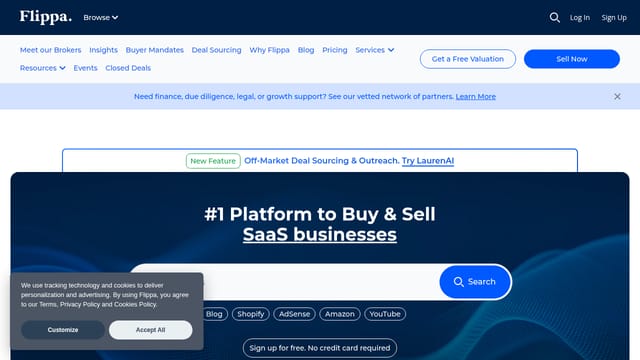
The largest marketplace for digital-asset acquisitions including YouTube channels. Wider inventory than Empire Flippers; quality varies more. The right starting point for buyers under $100K budgets.

Higher-end marketplace with stricter listing diligence. YouTube channel inventory is smaller but the financials are better-documented. Right pick for $50K+ budgets.
Broader marketplace including YouTube and content-business listings. Solid alternative for the $25K-150K range with growing inventory in 2026.

Channel analytics + competitor research. Mandatory pre-purchase due diligence — you need to verify claimed view counts, engagement, and audience demographics before transferring funds.