Expired Domain Auctions: GoDaddy vs SnapNames vs DropCatch
EditThree platforms compete for the best dropping domains every day. The platform you bid on determines which inventory you see and how you'll lose to other investors.
TL;DR (the honest verdict)
Use GoDaddy Auctions as your primary venue. Largest inventory, transparent bidding, lowest fees for the typical hand-reg-to-aftermarket investor.
Use SnapNames or DropCatch for specific drop-catching scenarios where GoDaddy doesn’t have the inventory — typically high-value names that other catchers grab before they enter GoDaddy’s expired stream.
Skip NameJet in 2026 — merged into other platforms; inventory has thinned.
Skip “premium auction” platforms (Sedo Premium, Afternic GoValue) for buying. Those are sales platforms, not catch venues. Different category.
The honest one-liner: GoDaddy for 95% of the inventory you’ll bid on, SnapNames/DropCatch for the high-stakes minority.
Quick comparison table
| GoDaddy Auctions | SnapNames | DropCatch | |
|---|---|---|---|
| Inventory size | Massive (largest) | Medium | Medium |
| Membership cost | $4.99/year | Free | Free |
| Auction fees | 15% of sale | 15% of sale | 15-30% varies |
| Catch reliability | High (own registrar pipeline) | High (own catching infrastructure) | Highest for premium drops |
| Minimum bid | $5-$12 | $59 | Varies |
| Bidding window | 7-10 days typical | 1-3 days at expiration | Last-minute sniping common |
| Best for | Volume + budget hand-regs | Specific medium-tier drops | Premium drops you must win |
| Withdrawal/refund policy | Strict | Strict | Strict (varies by lot) |
| API for power users | Yes | Limited | Yes (DropCatch.com Pro) |
| Affiliate program | Yes (referral) | No | No |
How expired domain auctions actually work
When a domain registration expires, it goes through a 75-day cycle before being released back to the public registration pool:
- Day 1-30 (grace period): owner can renew normally.
- Day 30-60 (redemption period): owner can renew with a $80-$200 redemption fee.
- Day 60-65 (pending delete): domain is locked, awaiting drop.
- Day 65-75 (drop window): registry releases the domain. This is when “drop catchers” pounce.
GoDaddy, SnapNames, DropCatch, and others run massive registrar networks that attempt to grab high-value domains the moment they hit the registry’s release pool. They send hundreds of registration requests per second per domain, hoping one wins the race.
Once a catcher wins, they auction it. You’re not bidding for a domain; you’re bidding to be the buyer who pays the catcher.
This is why prices vary so wildly. A common name you could hand-register tomorrow goes for $9. A name that 4-5 catchers all wanted goes through an auction war and lands at $500-$50,000.
The platform deep-dive
GoDaddy Auctions
The default venue. GoDaddy is the world’s largest registrar, which means:
- Most expiring domains expire on GoDaddy. When they don’t renew, GoDaddy auctions them first (before other catchers can grab them).
- Lower minimum bids mean you’ll find $9-$50 entry-point auctions regularly. Volume players with $500-$2,000 capital get most of their portfolio from here.
- Membership ($4.99/year) is required to bid above $5,000 and to access “premium” listings. Worth it for any active investor.
Where GoDaddy wins:
- Inventory volume — 50,000+ active auctions on any given day.
- Easy interface for beginners.
- Reliable post-auction transfer process.
- Affiliate-program participation — a referral angle if you’re recommending in your content.
Where GoDaddy falls short:
- High-end drops occasionally bypass GoDaddy (when other catchers grab them at the registry first).
- Last-minute auction extensions can drag bidding wars longer than expected.
- Overlapping auctions — same domain occasionally listed in pre-release AND closeout, confusing process.
Best for: new investors learning the market, volume buyers (3-10+ bids per week), the bulk of $50-$500 winning bid auctions.
SnapNames
A specialized drop catcher. SnapNames’ infrastructure is optimized for grabbing specific high-quality drops that GoDaddy misses or doesn’t get first.
Where SnapNames wins:
- Strong catch rate on premium one-word and short two-word .coms.
- Free membership.
- Cleaner interface for premium bidding (less of a flea-market feel than GoDaddy’s volume listings).
Where SnapNames falls short:
- Smaller total inventory.
- Higher minimum bid ($59) prices out a lot of hand-reg-tier opportunities.
- Less liquid for medium-tier domains (fewer competing buyers, but also fewer interesting listings).
Best for: investors with $300+ per-bid budget targeting specific high-quality drops they’ve identified through ExpiredDomains.net pre-auction research.
DropCatch
The most aggressive premium drop catcher. DropCatch operates a network of 3,000+ shell registrars, allowing them to fire registration attempts from many independent IPs simultaneously — which gives them an edge on the most contested drops.
Where DropCatch wins:
- Highest catch rate on the most contested drops.
- API for power users.
- Genuine premium-tier inventory (occasional 4-figure-and-up names that don’t appear elsewhere).
Where DropCatch falls short:
- Higher fee structure on some lots (15-30% varies).
- Steeper learning curve (interface assumes domain-investor familiarity).
- Premium-only mindset means few sub-$100 opportunities.
Best for: experienced investors with $500+ per-bid budget, going after specific high-stakes drops where catch reliability matters more than fee minimization.
The 5-step process for first-time bidders
Step 1: Build a watch list (free, before you bid anywhere)
- Sign up for ExpiredDomains.net (free).
- Filter to .com, 5-12 letter, no numbers, no hyphens, with metrics: archive presence yes (real domain history), Majestic Trust Flow >5, no obvious trademark issues.
- Build a list of 50-100 names dropping in the next 14 days.
- For each, do 60 seconds of due diligence:
- Check the Wayback Machine for prior content.
- Search for the name in Google to spot any current trademark conflicts.
- Quick Estibot appraisal as a sanity check (don’t trust as gospel).
Step 2: Pick your first 3-5 to bid on
Don’t bid on 30 things at once. Pick a small initial batch. Set a hard budget per name (the price above which you walk away) before you log into the auction site.
Budget setting framework:
- Minimum bid + $5-$30 if you’re testing.
- Up to 1/3 of estimated retail value if confident.
- NEVER bid above 50% of conservative retail estimate. This is the line that separates investors from gamblers.
Step 3: Bid and walk away
The cardinal rule of expired auctions: set your max bid, then close the tab. Don’t watch. Don’t refresh. Don’t engage with the gamification.
Auction platforms are designed to extract your money through emotional bidding. The investor who places one bid at their pre-decided maximum and walks away outperforms the investor who increments through the bidding process by reflex.
GoDaddy supports proxy bidding — you set your max, and the system bids on your behalf only as needed. Use it.
Step 4: Win or lose, evaluate
If you win:
- Transfer the domain to your registrar of choice (Namecheap if cost-conscious; GoDaddy is fine if you bought there).
- Set up a for-sale landing page (Sedo, Atom, Afternic).
- Note your win in a spreadsheet — purchase date, price paid, target sell price, why you bought.
If you lose:
- Note the closing price. Was it 2x your max? 5x? This calibrates your future bidding.
- Don’t chase. There’s another auction tomorrow.
Step 5: After 30-60 days, audit your buys
Review every domain you’ve won:
- Has it been viewed on the marketplaces? (Sedo + Atom show inquiry stats.)
- Have you received any inbound offers?
- Would you have re-bid the same amount today, knowing what you now know?
Patterns emerge. The names you regret buying share traits — too long, too generic, trademark-adjacent. Tighten your buy criteria for next round.
Common mistakes (and how to avoid them)
Mistake 1: Bidding on names you don’t have a buyer for
If you can’t articulate “this would be bought by [specific buyer type] at [specific price]” — don’t bid. “Maybe someone might want it” is not a buyer profile.
Mistake 2: Falling in love with a domain
Emotional buys are the #1 capital killer in domain investing. The fix: write your max bid before opening the auction. Don’t change it.
Mistake 3: Skipping trademark checks
A trademark-violating domain isn’t an asset, it’s a legal liability. USPTO TESS + Google search take 90 seconds per name. Always do them.
Mistake 4: Ignoring renewal cost compounding
Some TLDs renew at $30, $50, or $180/year. A 5-year holding period at $180/year is a $900 renewal cost. Make sure your sale-price expectation comfortably covers it.
Mistake 5: Chasing prices in bidding wars
When two other bidders are fighting over a name, the closing price almost always exceeds the rational ceiling. Set your max, walk away, let them overpay.
Mistake 6: Bidding without first studying the market
Spending one weekend reading recent sales on DNJournal beats spending six months “learning by doing” with real money. The market has structure; learn it cheap.
What budget makes sense
| Budget | What’s realistic |
|---|---|
| $100-$300 (first 3 months) | 3-8 small wins at GoDaddy, mostly $20-$50 each |
| $300-$1,000 (first year) | 10-20 wins, $50-$200 average bid |
| $1,000-$5,000 (year 2) | Selective higher-tier wins, more SnapNames participation |
| $5,000+ (year 3+) | DropCatch participation, premium drops, multi-platform diversification |
Most successful long-term investors start small, lose more than they win, and tighten criteria over time. Variance is high; the base rate dominates over years not months.
Common questions
Should I drop-catch myself rather than bidding?
You can register expiring domains the moment the registry releases them, but unless you’ve built infrastructure to fire 100s of requests per second from many IPs, you’ll lose to the professional catchers (GoDaddy, SnapNames, DropCatch) on any name that has interest. Don’t bother.
Are “closeout” auctions on GoDaddy worth bidding on?
Closeouts are auctions GoDaddy got but where no one bid above the reserve. Prices drop progressively over 5 days until someone bids. Closeouts are the best beginner battlefield — most buys are $5-$12, low downside, occasional gems.
Do I need a tool subscription to be effective?
Estibot ($19/month) and similar tools speed up triage. Worth it once you’re bidding regularly. Start free with ExpiredDomains.net + Wayback Machine — you can be effective without paid tools for the first 100 hours of practice.
What about international drops (non-.com)?
Country-code TLDs have their own drop ecosystems with regional catchers. The market is much thinner; not recommended for first-time investors. Stay in .com (and maybe .ai/.io) initially.
Can I sell domains I won at auction immediately?
Yes, but most won-at-auction domains take 6-18 months to find a buyer. Plan accordingly. Don’t bid more than you can afford to have locked up for 1-2 years.
The actual recommendation
For someone reading this and deciding right now where to start:
- GoDaddy Auctions for 95% of your bidding, especially in the first 12 months while you learn the market.
- SnapNames secondary when you’ve identified specific premium drops worth $200+ per name.
- DropCatch tertiary for a small handful of high-stakes drops where you want maximum catch reliability and you’re willing to pay for it.
Skip the rest until you have a year of experience and a clearer thesis on what you’re trying to buy.
Action plan
- Today: sign up for GoDaddy Auctions ($4.99/year membership). Sign up for ExpiredDomains.net (free).
- This week: spend 3 hours studying. Browse closing auctions. Note what’s selling for what. Don’t bid yet.
- Next week: build a watch list of 20 names dropping in 7-14 days. Apply the buy criteria from our domain investing guide. Decide a max bid for each.
- Week 3: place your first 3-5 bids using proxy bidding. Set max, walk away. Win or lose without watching live.
- Months 2-6: continue 5-10 bids per week. Track every win and miss in a spreadsheet. Tighten criteria as patterns emerge.
By month 6 you’ll have a portfolio of 20-40 won domains, calibrated bidding, and the start of a real domain-investing practice. By month 12, you’ll have your first 1-3 sales. By year 2, you’re either profitable and scaling, or you’ve identified that this isn’t your game and you’ve moved on with $500-$1,500 lost as tuition.
Either outcome is fine. The 90-day commitment to learn the auction process before scaling is what separates investors from gamblers.
Recommended tools
Affiliate disclosure: links may earn TierIncome a commission at no cost to you.
Largest expired-domain marketplace globally. The default starting venue for any serious investor — most quality drops flow through here first.
After winning at auction, transfer wins to Namecheap for cheap renewals. Saves $5-$15 per domain per year vs leaving them on more expensive registrars.
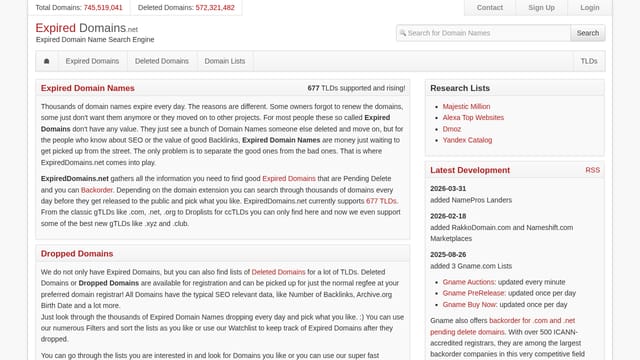
Free database aggregating drops across registries. Build watch lists with metric filters (Majestic Trust Flow, archive history, backlinks).
Quick automated appraisal for filtering auction candidates. Pair with manual research — never bid based on appraisal alone.