Best P2P lending platforms for EU residents in 2026
EditFive EU peer-to-peer platforms ranked by net yield after defaults, buyback-guarantee strength, originator diversification, and how they actually behaved through the 2020-2024 stress cycle.
EU P2P lending finished consolidating around 2026. The fragmented, dozens-of-platforms market of 2017-2020 is now a five-name race plus a long tail of niche operators that never quite made it through MiFID. The platforms below have all cleared at least one full stress cycle (COVID 2020, Russia/Ukraine originator defaults 2022, rising-rate environment 2022-2024) and continue to operate transparently in 2026.
The ranking assumes you’re allocating for realistic net yield — gross advertised APY minus the 2-3pp annualized loss that historically came from defaults, originator failures, and platform-level stress. If you’re chasing the 12-13% headlines, you’re picking the wrong frame; that number has not been the realized yield for any retail allocator on any of these platforms over a full cycle.
How EU P2P actually works (and where the risk really lives)
A P2P lending platform is not a bank that pays you interest. It is a marketplace that connects you (the lender) with consumer or business loans originated by a third party (the originator). Three risk layers stack:
- Loan default — the borrower stops paying. Base rate 4-8% on consumer P2P, recovered partially through collections.
- Originator buyback — the originator promises to repurchase defaulted loans at face value (typically after 60 days delinquent). This is the line every platform’s marketing leans on, and it is only as strong as the originator’s balance sheet. When originators fail (Mogo 2020, multiple smaller ones 2022-2023, Russian-exposed originators across 2022), buyback claims become unsecured creditor claims.
- Platform operational risk — the platform itself can fail or operate below standards. Mintos 2020-2021 is the canonical stress test. The platform survived; multiple smaller ones didn’t.
Real net yields after all three layers cluster in the 6-9% range across the top platforms over multi-year holds. Anything you’re advertised above that has historically reverted toward that band; it just takes 1-2 stress events to find out.
The 2022-2024 cycle was the real test
Every EU P2P platform survived COVID. Most platforms talk about that as if it proved the model. It didn’t — the COVID stress was a brief liquidity event that EU governments papered over with consumer-credit moratoria.
The real test was 2022-2024:
- Russia’s invasion of Ukraine wiped out exposure to Ukrainian originators on multiple platforms (Mintos and several smaller competitors had material exposure).
- Rising rates compressed originator margins across consumer credit, leading to a wave of originator failures in 2022-2023.
- MiFID II implementation forced operating-model changes; platforms that couldn’t adapt exited (multiple did).
- EU real-estate softness in 2023-2024 pushed real-estate-collateralized platforms into longer recovery cycles.
The five platforms above all kept paying through that. The ones that exited or cut yields meaningfully are not on this list — and that survivor selection is more meaningful than any single yield headline.
Buyback-guarantee strength is the only number that matters
The “advertised APY” line is decoration. The line that determines whether you keep your money is the originator’s ability to honor buyback when default rates spike. Three things to check before allocating to any originator on any platform:
- Public financials. Originators that publish audited annual reports can be evaluated. Originators that don’t (still common in EU P2P) are unknowable; treat them as binary high-risk allocations regardless of what the platform’s “originator rating” says.
- Group structure. When an originator belongs to a holding group with diversified operations (Aventus Group, Robocash Group, Mogo Finance), the group’s balance sheet provides a second backstop. Standalone originators have only their own loan book.
- Stress history. Originators with no record through a 2022-style event are unproven, even if their current default rates look pristine. The first 18 months of any new originator’s published numbers are not informative.
A platform that lets you filter Auto-Invest by group-backed originators is doing 60% of the diversification work for you. A platform that doesn’t is asking you to do the originator-by-originator due diligence yourself.
What does NOT work in 2026
- Allocating 100% to one platform. Even the top platform on this list has had operational stress. Three-platform diversification (one consumer-credit marketplace, one real-estate, one EM-exposure) costs nothing operationally and removes most of the platform-level risk.
- Chasing the 12-13% APY headline. Real net yields don’t materialize there over a full cycle. The capital you allocate to a 13% advertised yield-trap originator earns 5-7% net after the inevitable defaults — worse than the 8-9% safe-originator alternative.
- Keeping all your liquidity in P2P. Even Bondora Go & Grow can delay withdrawals under stress (used the option briefly in 2020). P2P should never be your emergency fund or your monthly-bill float.
- Ignoring the tax angle. Most EU jurisdictions tax P2P interest as ordinary income — at marginal rates that can wipe 30-40% of the gross yield. After-tax P2P yields are usually closer to 5-6% net for high-bracket taxpayers, which changes the comparison vs dividend ETFs and bond funds.
Final picks by profile
- First-time P2P lender, cautious: Bondora Go & Grow only. Lower yield, simplest mental model, fastest exit. €1K-5K to learn the mechanics before scaling.
- Building a diversified P2P stack: Mintos (60%) + PeerBerry (25%) + Estateguru (15%). Consumer-credit core, clean-record secondary, real-estate diversifier.
- Yield-maximizer, accepts more risk: Mintos with Auto-Invest set to medium-rated originators (40%) + Robocash for EM exposure (30%) + PeerBerry quality screen (30%). Expected net yield 8-10% if originators behave; 5-7% net through a stress cycle.
- Holding a real-estate-only thesis: Estateguru as the single platform; accept the 12-24 month recovery cycle on defaults as the cost of collateral-backed exposure.
The wrong call here is treating P2P like a savings account because the marketing reads that way. Treat it like an unsecured loan to a consumer-finance operator: spread it across multiple platforms and originators, allocate only what you can leave for 2-3 years through stress, and check the underwriting numbers quarterly. Done that way, EU P2P remains one of the cleanest 6-8% net-yield products available to a EUR-resident allocator.
Quick verdict
- #1 Mintos — The default EU P2P platform — largest by AUM, MiFID-licensed, deepest originator network, recovered cleanly from 2020-2021 stress. 8.7
- #2 PeerBerry — Cleanest buyback record through the 2022-2024 stress window — narrower originator selection (mostly Aventus Group, Gofingo) but a record of paying through. 8.4
- #3 Bondora Go & Grow — Flat 6.75% yield with daily liquidity — the simplest hands-off P2P product available, but the structure is materially different from a buyback-marketplace. 7.9
- #4 Estateguru — EU real-estate-backed loans — collateral exists, recovery is slower but feasible, fundamentally different risk profile from consumer-credit platforms. 7.5
- #5 Robocash — Asia-Pacific originator network for EU residents — diversification away from the EU consumer-credit cluster every other platform overlaps on. 7.2
The ranking

Mintos
The default EU P2P platform — largest by AUM, MiFID-licensed, deepest originator network, recovered cleanly from 2020-2021 stress.
- Best for
- EU residents with €1K-50K wanting the broadest diversification and accepting platform-leader operational history.
- From
- 0% fee; yield gross of originator
- Commission
- Mintos referral program — bonus for new referees
Pros
- MiFID II investment-firm license — strongest regulatory standing in the EU P2P space
- 30+ active loan originators across 12+ countries — diversification by originator, country, and currency built in
- Auto-Invest with granular filters (LTV, originator rating, currency, term) — set once, deploys for months
- Recovered transparent operations after 2020-2021 originator-failure cycle with full buyback delivery on most exposures
Cons
- Platform-level stress in 2020-2021 (operational, not insolvent) shows centralized P2P models have one-throat-to-choke risk
- Best yields require accepting smaller, riskier originators — quality-filtered Auto-Invest yields cluster in the 7-9% range, not 11-12%
- Notes-based product structure (post-MiFID) is more complex than the old fractional-loan model — read the prospectus
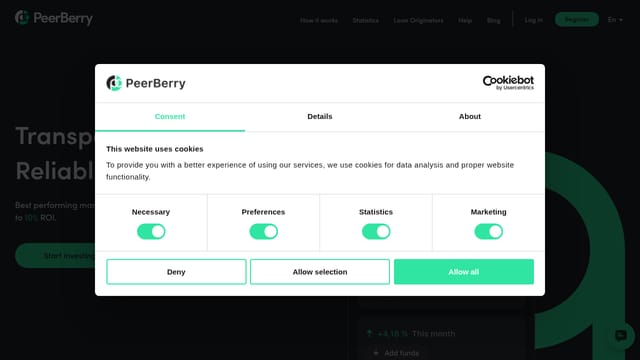
PeerBerry
Cleanest buyback record through the 2022-2024 stress window — narrower originator selection (mostly Aventus Group, Gofingo) but a record of paying through.
- Best for
- Investors prioritizing a clean payment record over breadth and accepting Aventus Group concentration.
- From
- 0% fee; yield gross of originator
- Commission
- PeerBerry refer-a-friend bonus, both sides
Pros
- Clean buyback execution through 2022-2024 — no investor losses on the war-impacted Ukrainian originator exposure
- Tighter originator screen than Mintos — fewer choices, but every active originator has cleared multiple stress windows
- Group guarantee from Aventus Group adds a second layer beyond originator buyback (subject to group solvency, but historically has paid)
- Cleaner UX and faster auto-invest deployment than Mintos for new investors
Cons
- Heavy concentration in Aventus Group originators — diversification within the platform is more illusion than reality
- Smaller AUM and shorter operating history than Mintos — less of a track record through full cycles
- Limited currency options compared to Mintos; mostly EUR-denominated which is fine for EU residents but constrains diversification
Bondora Go & Grow
Flat 6.75% yield with daily liquidity — the simplest hands-off P2P product available, but the structure is materially different from a buyback-marketplace.
- Best for
- Investors valuing liquidity and simplicity over yield, wanting a savings-account-like experience plus a few points.
- From
- 0% fee; flat 6.75% advertised yield
- Commission
- Bondora refer-a-friend bonus
Pros
- Withdrawals available within 1-2 business days under normal market conditions — the most liquid P2P product in the EU
- Flat advertised yield with no auto-invest configuration to manage
- 10+ year operating history through 2008 GFC, COVID, and the 2022 cycle without a missed Go & Grow payment to date
- Cap of €400/month on incoming funds is gone for legacy accounts; new accounts open under MiFID structure with broader limits
Cons
- Yield is materially lower than buyback-marketplace alternatives — 6.75% vs 8-10% real net yields elsewhere
- Liquidity is contractual, not absolute — Bondora reserves the right to delay withdrawals during stress (used the option briefly in 2020)
- Underlying loan book is concentrated in Bondora-originated Estonian, Finnish, Spanish consumer credit — single-originator risk

Estateguru
EU real-estate-backed loans — collateral exists, recovery is slower but feasible, fundamentally different risk profile from consumer-credit platforms.
- Best for
- Investors wanting collateral-backed P2P exposure and accepting slower cycling for different risk drivers.
- From
- 0% explicit fee; yield gross
- Commission
- Estateguru refer-a-friend bonus
Pros
- Loans secured against EU property — recovery on default is slow but real, unlike consumer-credit buyback
- Geographic diversification across Baltic + Nordic + DACH real-estate markets
- Realistic 8-11% gross yields with collateral backing — risk-adjusted returns competitive with consumer P2P
- Public delinquency and recovery dashboards — transparency is materially better than the consumer platforms
Cons
- Recovery cycles can stretch 12-24 months on defaulted loans — your capital is locked through that window
- Net realized yields have meaningfully trailed advertised yields through 2022-2024 (rising-rate impact on EU real estate)
- Concentration in commercial / development real estate adds cyclical risk that consumer P2P doesn't have
Robocash
Asia-Pacific originator network for EU residents — diversification away from the EU consumer-credit cluster every other platform overlaps on.
- Best for
- Investors already running Mintos or PeerBerry who want geographic diversification away from EU/CIS consumer credit.
- From
- 0% explicit fee; yield gross
- Commission
- Robocash refer-a-friend bonus
Pros
- Originator network in Vietnam, Indonesia, Philippines, Sri Lanka, Singapore — diversification beyond the EU/CIS cluster
- Higher advertised yields (11-13%) reflecting EM consumer-credit risk premia
- Auto-invest with strong defaults; product complexity is lower than Mintos's notes structure
- Group guarantee from Robocash Group (publicly listed in Singapore) adds a second-layer backstop
Cons
- Concentration is 100% within the Robocash Group ecosystem — no third-party originators on the platform
- EM consumer-credit cycle moves differently from EU/CIS — additional fundamentals research required to assess
- Smaller AUM and shorter operating history than the top three
Frequently asked questions
What is the best option in Best P2P lending platforms for EU residents in [year]?
Mintos ranks #1 with a score of 8.7/10. The default EU P2P platform — largest by AUM, MiFID-licensed, deepest originator network, recovered cleanly from 2020-2021 stress.
Who is Mintos best for?
EU residents with €1K-50K wanting the broadest diversification and accepting platform-leader operational history.
Who is PeerBerry best for?
Investors prioritizing a clean payment record over breadth and accepting Aventus Group concentration.
Who is Bondora Go & Grow best for?
Investors valuing liquidity and simplicity over yield, wanting a savings-account-like experience plus a few points.
How is this ranking decided?
Each platform was scored on five things that move net return for an EU retail lender: realistic net yield (advertised APY minus the 1-3pp typical loss to defaults and originator failures), buyback-guarantee strength (originator size + recovery record), originator + geographic diversification, regulatory standing (MiFID licensing post-2022), and operational record through the 2020-2024 stress window (COVID, Russia/Ukraine, rising rates). Yields are quoted from each platform's published rate sheet as of the article date.