Best newsletter platforms for paid subscriptions in 2026
EditFive honest picks for monetizing a newsletter — ranked by what they actually unlock for the writer who has to grow, charge, and keep the lights on without a design team.
The newsletter category has converged. Five platforms now cover roughly 95% of working writers — and they trade off in different directions: Beehiiv on growth and sponsorships, Substack on default audience, Ghost on ownership, Kit on funnels, MailerLite on price. None of them are universally best; what’s right depends on whether you’re optimizing for time-to-first-dollar, long-term economics, or owning the asset outright.
The ranking below assumes you intend to make money from the newsletter — directly or indirectly. If you’re writing as a hobby, the cheapest option that emails people is fine. If you’re building a business, the cost of the wrong choice shows up later as a 10% revenue tax (Substack), a stalled growth curve (MailerLite), or six months of migration pain (everyone). Choose with the next two years in mind, not the first.
Quick verdict
- #1 Beehiiv — Built by ex-Morning Brew operators for newsletters that need to grow and monetize from day one. 9.2
- #2 Substack — The default audience platform — write, hit publish, and let the recommendation engine do the discovery. 8.6
- #3 Ghost — Open-source publication platform — closer to a media business than a newsletter, with full ownership and a real CMS. 8.4
- #4 Kit (ConvertKit) — Creator-focused email platform with the cleanest automation and product-selling flows in the category. 8.1
- #5 MailerLite — The pragmatic budget pick — clean editor, fair pricing, no ambition to be a media platform. 7.6
The ranking

Beehiiv
Built by ex-Morning Brew operators for newsletters that need to grow and monetize from day one.
- Best for
- Writers who want sponsorships, paid tiers, and aggressive growth tools in one place.
- From
- Free up to 2,500 subscribers
- Commission
- 50% recurring (3 months) via Beehiiv Partner program
Pros
- Native ad network and boost program — sponsorship revenue without cold outreach
- Referral system, polls, and segmentation in the free tier
- Full subscriber export at any time; no lock-in
- Paid subscriptions on the Scale plan with low platform take
Cons
- Editor is functional but less polished than Substack's
- Custom domains require the Grow plan or higher
- No native podcasting or full CMS pages like Ghost
Substack
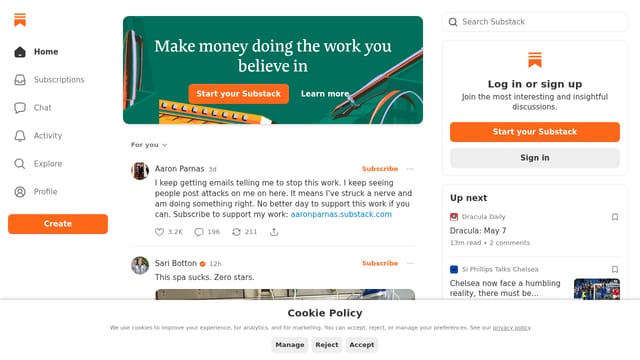
The default audience platform — write, hit publish, and let the recommendation engine do the discovery.
- Best for
- Journalists and individual writers who want speed and built-in audience over flexibility.
- From
- Free; 10% on paid subscriptions
- Commission
- No public affiliate program
Pros
- Network-effect discovery via Notes, recommendations, and Substack app
- Zero setup — paid subscriptions live in under ten minutes
- Strongest brand recognition among readers; "subscribe" feels frictionless
- Native podcast hosting included
Cons
- 10% platform fee on paid subscriptions (plus Stripe) — meaningfully eats into MRR at scale
- Limited segmentation, automation, and design control
- You're a tenant on someone else's brand; serious operators eventually outgrow it
Ghost
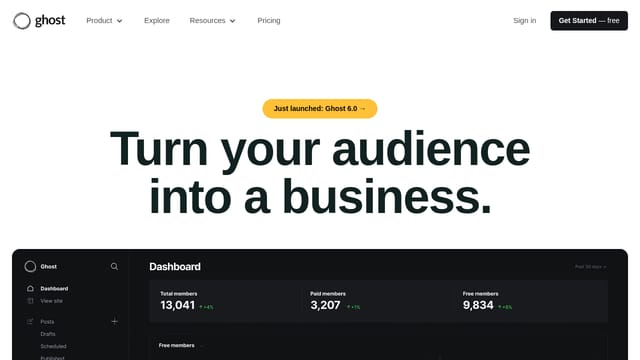
Open-source publication platform — closer to a media business than a newsletter, with full ownership and a real CMS.
- Best for
- Operators who want a publication, not just a newsletter — and who plan to scale past one revenue stream.
- From
- $9/mo on Ghost(Pro); free if self-hosted
- Commission
- No standard affiliate program
Pros
- Full website + newsletter + memberships in one self-hostable platform
- 0% platform fee on paid subscriptions (only Stripe processing)
- Custom themes, full SEO control, native portal for member management
- Self-hosted option keeps data and costs entirely under your control
Cons
- Self-hosting requires real DevOps comfort; Ghost(Pro) costs more at small scale
- Smaller built-in discovery surface than Substack
- Email deliverability depends on your Mailgun configuration on self-host
Kit (ConvertKit)
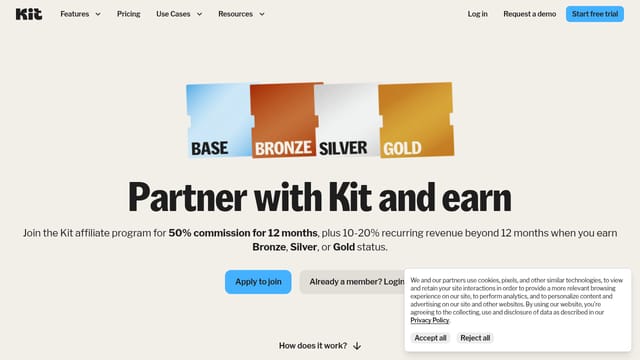
Creator-focused email platform with the cleanest automation and product-selling flows in the category.
- Best for
- Creators selling courses, ebooks, or coaching alongside the newsletter.
- From
- Free up to 10k subscribers (limited)
- Commission
- 30% recurring lifetime via Kit Partner program
Pros
- Visual automation builder — sequences, tags, and conditional flows that scale with the funnel
- Built-in product sales (digital downloads, courses, subscriptions) with low fee
- Strong landing-page builder; doubles as a creator hub
- Healthy creator network and recommendation surface (Creator Network)
Cons
- More expensive per subscriber than Beehiiv at the same scale
- The "newsletter" experience is functional but less editorial than Substack or Ghost
- Free tier is capped at 10k subscribers and limits automation features
MailerLite
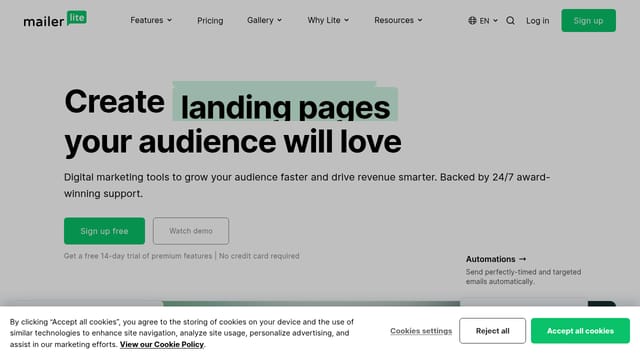
The pragmatic budget pick — clean editor, fair pricing, no ambition to be a media platform.
- Best for
- Writers who already have audience and just need a reliable, cheap way to send and grow their list.
- From
- Free up to 1,000 subscribers
- Commission
- 30% recurring via MailerLite Partner program
Pros
- Cheapest serious option at 1k–25k subscribers
- Clean drag-and-drop editor; landing pages and forms included
- Solid deliverability; not associated with the newsletter-spam reputation other budget tools have
- Permits affiliate marketing content unlike many competitors at this tier
Cons
- No built-in audience or recommendation engine
- Paid subscriptions require Stripe + workarounds rather than a native flow
- Brand and reader-facing surfaces are basic; you need your own site for credibility
Frequently asked questions
What is the best option in Best newsletter platforms for paid subscriptions in [year]?
Beehiiv ranks #1 with a score of 9.2/10. Built by ex-Morning Brew operators for newsletters that need to grow and monetize from day one.
Who is Beehiiv best for?
Writers who want sponsorships, paid tiers, and aggressive growth tools in one place.
Who is Substack best for?
Journalists and individual writers who want speed and built-in audience over flexibility.
Who is Ghost best for?
Operators who want a publication, not just a newsletter — and who plan to scale past one revenue stream.
How is this ranking decided?
Each platform was scored across five things that matter to a writer running a one-person publication: monetization leverage (how easy it is to charge), distribution (built-in audience or referral mechanics), deliverability (spam-folder rate at low volumes), ownership of the list (export rights, lock-in), and pricing economics at 1k, 10k, and 50k subscribers. Affiliate disclosures and free-tier limits were verified against the providers' published terms as of the article date.