Best crypto staking platforms in 2026
EditFive honest picks for putting ETH, SOL, and DOT to work — ranked by net yield after fees, liquidity, custody trade-offs, and where your jurisdiction actually lets you stake.
The staking category quietly grew up. What was a fragmented mess of unaudited DeFi pools and exchange opt-ins three years ago is now a four-tier market: liquid-staking protocols (Lido, Rocket Pool), regulated centralized exchanges (Coinbase, Kraken), wide-menu exchanges (Binance Earn), and solo home validation. The five platforms below cover roughly 90% of working stakers in 2026, and they trade off in three directions: net yield, custody, and jurisdictional access.
The ranking assumes you actually want to keep what you stake. If you’re chasing a 12% APY headline on a chain you’ve never heard of through a platform with no proof-of-reserves, that’s not staking — that’s an unsecured loan to a stranger. Every platform here has a real validator operation behind it and a record of paying rewards through at least one full bear cycle.
How to read this list
Three numbers matter for any staking decision, in this order:
- Net yield to you — the protocol APR minus the platform’s commission cut. A 4% gross yield with a 35% commission (Coinbase) leaves you 2.6% net. The same 4% with a 10% commission (Lido) leaves you 3.6%. Over five years on a $10K stake, that’s the difference between $1,400 and $1,940 in real returns.
- Custody risk — who holds the keys. Custodial platforms (Coinbase, Kraken, Binance) can freeze, delist, or fail; non-custodial protocols (Lido, Rocket Pool) substitute smart-contract risk and peg risk for counterparty risk. There’s no free pick; choose the failure mode you can monitor.
- Jurisdictional access — staking-as-a-service is regulated differently in the US, EU, UK, and Asia, and the rules change yearly. The platform that tops every other axis is irrelevant if your jurisdiction blocks signup. EU residents in particular benefit from MiCA-licensed exchanges (Kraken, Binance Europe) that US sites rarely flag.
Asset selection comes fourth. If you only stake ETH, you have more good options than you’ll ever use. If your portfolio includes SOL, DOT, ATOM, or NEAR, the choice narrows fast — usually toward Binance or a chain-specific protocol the exchange-tier doesn’t support.
The honest math on Ethereum staking
Ethereum’s protocol-level staking yield was roughly 3.0-3.5% APR through most of 2026, down from the post-merge 5%+ levels as more ETH joined the validator set. After platform fees, the realistic net yields look like:
- Solo home validation (32 ETH minimum): 100% of protocol APR, ≈ 3.0-3.5% — but with full uptime responsibility, slashing risk, and the operational overhead of running a validator.
- Lido (10% fee): ≈ 2.7-3.2% net, plus DeFi yield on stETH if you put it to work.
- Rocket Pool (14% fee): ≈ 2.6-3.0% net.
- Kraken (15% fee): ≈ 2.6-3.0% net.
- Coinbase (25-35% fee): ≈ 2.0-2.6% net.
That’s the ETH-staking yield. SOL pays substantially more (5-7% net on most platforms), DOT and ATOM higher still (8-15% net but with longer unbonding periods and more inflation-driven nominal returns).
The takeaway: on a $10K ETH stake over five years, picking the wrong platform costs you ~$500-700 in foregone net yield. Worth the 30 minutes of comparison.
Custodial vs non-custodial: pick your failure mode
The biggest decision isn’t which platform — it’s which custody model.
Custodial (Coinbase, Kraken, Binance): the platform holds the private keys. You log in with email and password, and your stake appears as a balance line in their app. Failure modes are familiar: account freezes, jurisdiction-driven delistings, exchange insolvency (rare but real — see Celsius, FTX, Voyager). Reward: ten-second sign-up, no on-chain knowledge needed, often the best UX in crypto.
Non-custodial (Lido, Rocket Pool): you keep the keys; the staking happens through a smart contract. Failure modes are different: smart-contract bugs, governance failures, liquid-token peg dislocations under stress. Reward: lower fees, no platform-level account risk, your assets keep working even if the protocol’s website goes down.
Neither is universally safer. Custodial platforms have failed (multiple times), but so have DeFi protocols (multiple times). The question isn’t “which is safer” — it’s “which failure can you monitor and respond to?” If the answer is “neither, I’m not going to check this monthly,” go custodial with the most boring regulated option: Coinbase or Kraken.
What does NOT work in 2026
- Chasing the highest headline APY. Platforms quoting 12-20% on common L1s in 2026 are either running an unsustainable promotion or operating in a regulatory grey zone that may end abruptly. Real PoS yields cluster in tight ranges per chain (3-4% on ETH, 5-7% on SOL, 8-12% on DOT). Anything materially above that has a story you should read carefully.
- Treating liquid-staking tokens as ETH. stETH and rETH usually trade close to 1:1 with ETH, but that peg can break — and historically does, briefly, every couple of years. If you need ETH within a 30-day window, hold ETH; if you can hold the liquid token through volatility, the yield is real.
- Solo validation if you can’t promise uptime. Ethereum’s slashing rules are forgiving for honest mistakes but will still fine you for chronic offline behavior. If you travel, lose power monthly, or run validators on a residential connection without a backup, use a pool — losing 0.5% to slashing wipes out a year of yield.
- Locking long terms for marginally better APY. Binance and others offer locked staking products with a 0.5-1.5pp boost in exchange for 30-90 day locks. Almost never worth it; markets move faster than the boost compensates for, and the unlock window is rarely when you want to sell.
Final picks by user profile
- First-time staker, holds crypto on an exchange: Coinbase. The fee is high; the simplicity is worth it for your first year. Migrate later when you’re comfortable.
- EU resident with €1K-50K to stake: Kraken on ETH, Binance Europe for non-ETH assets. Both are MiCA-licensed; the combined fee economics beat Coinbase by 1-2pp net.
- DeFi-comfortable user maximizing ETH yield: Lido. The 10% fee is the best on the centralized-or-pooled options, and stETH liquidity in DeFi is genuinely useful (lending against it, LPing in Curve pools).
- Decentralization-first staker: Rocket Pool. Slightly worse economics than Lido; significantly better contribution to Ethereum’s network health.
- Multi-chain holder (ETH + SOL + DOT + ATOM + …): Binance Earn for the long-tail assets, Lido for ETH, accept that you’ll be running two platforms.
The wrong call here is paying Coinbase 35% on a five-figure ETH stake for ten years because the alternative looked technical. Spend the hour, set up the wallet, learn one transaction. The savings compound.
Quick verdict
- #1 Lido — The largest liquid-staking protocol on Ethereum — stake any amount, get stETH back, keep DeFi optionality. 9.1
- #2 Coinbase — The lowest-friction option for most US and EU users — staking lives next to your spot balance, no wallets required. 8.4
- #3 Kraken — Lower commission than Coinbase, longer track record on Ethereum, and the strongest pick for EU residents post-MiCA. 8.2
- #4 Rocket Pool — The decentralization purist's pick — smaller validator pool, higher network health contribution, rETH stays redeemable on-chain. 7.9
- #5 Binance Earn — The widest menu — stake everything from ETH and SOL to DOT, ADA, ATOM, NEAR, and a long tail of L1 tokens from one account. 7.5
The ranking
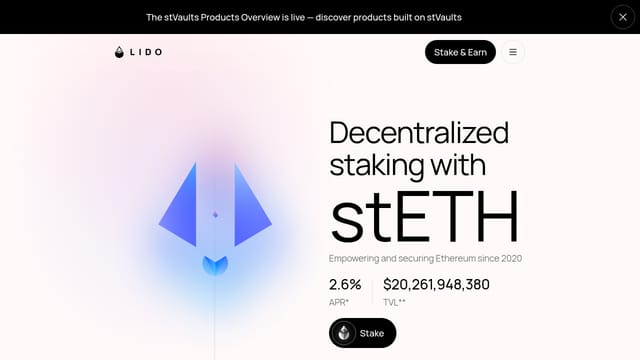
Lido
The largest liquid-staking protocol on Ethereum — stake any amount, get stETH back, keep DeFi optionality.
- Best for
- Stakers who already use a crypto wallet and want maximum yield with the option to redeploy stETH in DeFi.
- From
- 10% fee on staking rewards
- Commission
- No affiliate program (DAO-governed)
Pros
- No minimum stake — you don't need 32 ETH to participate in solo-validator economics
- stETH is liquid — tradeable, usable as collateral on Aave/Maker/etc., no 14-day exit queue when you want out
- Net yield typically 0.5-1pp higher than centralized exchanges thanks to the lower 10% fee
- Decentralized validator set across 30+ professional node operators
Cons
- stETH/ETH peg can dislocate under stress (briefly traded at 0.93 in mid-2022) — a real, repeating tail risk
- Smart-contract risk is non-zero; audits and a battle-tested record help, but not insurance
- You need a self-custody wallet and basic comfort with on-chain UX
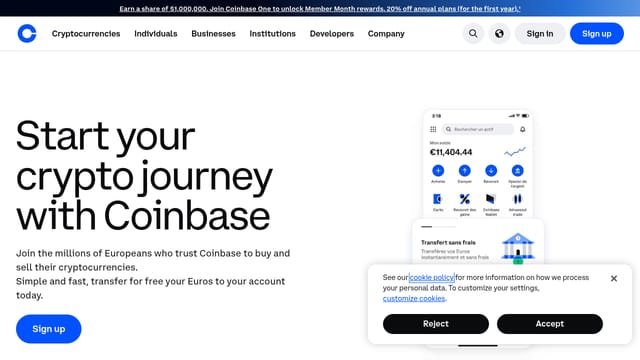
Coinbase
The lowest-friction option for most US and EU users — staking lives next to your spot balance, no wallets required.
- Best for
- Beginners who already hold crypto on Coinbase and want zero-effort yield without learning self-custody.
- From
- 25-35% commission on rewards
- Commission
- Up to $200 per qualified Advanced Trade referral
Pros
- Click-to-stake UX with no on-chain knowledge required; rewards auto-compound
- SEC-registered staking-as-a-service (post-settlement) — clearest regulatory standing of any US option
- Supports ETH, SOL, ADA, DOT, ATOM, MATIC, XTZ, and more from one account
- Insured custody (FDIC for fiat balances, internal coverage for crypto held)
Cons
- 25-35% commission cut on rewards — by far the highest in this list
- Custodial — Coinbase holds the keys; if they freeze your account, your stake freezes too
- Limited US states (varies by year and regulator action) and uncertain availability in some EU markets
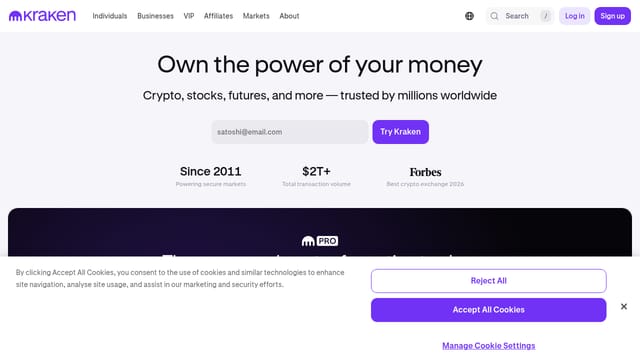
Kraken
Lower commission than Coinbase, longer track record on Ethereum, and the strongest pick for EU residents post-MiCA.
- Best for
- EU residents who want a regulated centralized option with better economics than Coinbase.
- From
- 15% commission on rewards (most assets)
- Commission
- Affiliate program with revenue share on referred trading fees
Pros
- 15% commission on most assets — meaningfully better economics than Coinbase
- Operating uninterrupted for ETH staking in the EU after exiting the US retail staking market in 2023
- 14+ supported assets including ETH, SOL, DOT, ADA, ATOM, MATIC
- Strong proof-of-reserves practice; one of the cleanest exchange security records in the industry
Cons
- On-chain ETH staking exit window can stretch to days under network congestion
- US retail users have lost direct staking access; off-platform workarounds add friction and risk
- UX is more "professional trader" than "crypto-curious beginner"
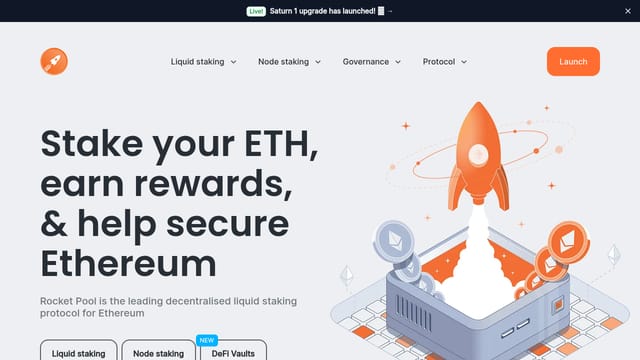
Rocket Pool
The decentralization purist's pick — smaller validator pool, higher network health contribution, rETH stays redeemable on-chain.
- Best for
- Stakers who care about Ethereum's decentralization and want a non-rebasing token for cleaner accounting.
- From
- 14% commission on staked rewards
- Commission
- No affiliate program
Pros
- Most decentralized staking pool on Ethereum by validator count
- rETH accrues yield in price (no rebasing), which simplifies tax accounting in some jurisdictions
- Permissionless validator onboarding (the protocol pays you to run a node with 8 ETH if you want to)
- Smaller pool = better contribution to Ethereum's stake distribution; aligned with long-term network health
Cons
- Lower TVL than Lido means rETH is less liquid in DeFi venues
- 14% commission on rewards — slightly worse than Lido
- Solo node operation requires 8 ETH plus RPL collateral and ongoing uptime responsibility
Binance Earn
The widest menu — stake everything from ETH and SOL to DOT, ADA, ATOM, NEAR, and a long tail of L1 tokens from one account.
- Best for
- Multi-asset stakers who want SOL, DOT, ADA, ATOM, NEAR yield without juggling five different wallets.
- From
- 0%; yield net of validator fee
- Commission
- 20-40% recurring on referee trading fees via Binance affiliate program
Pros
- Largest selection of stakeable assets of any platform — useful if your portfolio isn't ETH-only
- Flexible (no lock) and locked (higher APY) terms; you pick the trade-off per asset
- Auto-staking and auto-compounding for most assets
- Competitive APYs on smaller-cap PoS chains where exchanges are the only easy on-ramp
Cons
- Centralized + custodial (same trade-off as Coinbase, plus Binance's specific regulatory friction history)
- Restricted in several EU markets; Binance Europe (the post-MiCA EU entity) has a narrower asset list
- APY headline rates often include limited-time boosts that step down after the initial period
Frequently asked questions
What is the best option in Best crypto staking platforms in [year]?
Lido ranks #1 with a score of 9.1/10. The largest liquid-staking protocol on Ethereum — stake any amount, get stETH back, keep DeFi optionality.
Who is Lido best for?
Stakers who already use a crypto wallet and want maximum yield with the option to redeploy stETH in DeFi.
Who is Coinbase best for?
Beginners who already hold crypto on Coinbase and want zero-effort yield without learning self-custody.
Who is Kraken best for?
EU residents who want a regulated centralized option with better economics than Coinbase.
How is this ranking decided?
Each platform was scored across five things that actually matter to a long-term staker: net yield after the platform's commission cut, custody model (who holds the keys), liquidity (can you exit fast or are you locked into a 14-day unbonding queue), regulatory clarity in the US and EU as of [year], and operational reliability (uptime, slashing record, communication during incidents). Yields and fees are quoted as of the article date and were verified directly against each provider's published rate sheet.